Posted on 03 May 2009
eritrean-chinese-people1
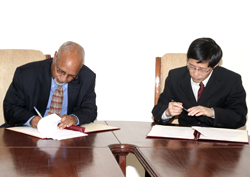
Chinese News Agency Xinhua reports that Chinese Ambassador to Eritrea Shu Zhan is expecting trade and cultural relations with Eritrea to be strengthened further. Shu points out that China has already aided a hospital, two schools and one human and social science institute to Eritrea and that trade volumes of China with Eritrea have reached $31 Million in 2008, which was a 7.6% increase compared to 2007.
The statements of the Ambassador follow previous steps taken by China and African countries to improve bilateral trade relations. For example, in August 2008 the China Development Bank signed a credit agreement worth $50 Million with PTA Bank, which stands for Eastern and Southern African Development Bank. The shareholders of the PTA Bank are Eritrea, Burundi, Comoros, Rwanda, Seychelles, Somalia, Ethiopia, Egypt, Djibouti, Kenya, Tanzania, Seychelles, Somalia, Sudan, Uganda, Zambia, Zimbabwe. The credit was supposed to support industrial sectors, which require heavy investment such as mining, telecommunication and infrastructure and was a result of the Bejing Summit of the Forum on China-Africa Cooperation in 2006. China is also involved in the gold mining projects in Eritrea with companies such as Donia Resources & Co (capitaleritrea).
Posted on 02 May 2009
The Xinhua News Agency reported that a delegation of the ruling communist party of china, also known as CPC left to an official visit to Eritrea, Kenya, Ghana, Cape Verde and Norway. The delegation left Bejing on Saturday 2. May to discuss bilateral relations with the five countries.
Posted on 12 April 2009
Paris, France: Due to the fact that China is becoming more aggressively dominant as a big player in nearly every business sector of the continent, rifts with other non-African nations doing business in Africa occur more frequently. (Article: China, Driver of African Busines by capitaleritrea).
The latest trade battle is fought by China against the Netherlands. Both Nations compete for the African Textile Industry, with the Netherlands owning the “Grand Fathers Rights” as an old and long established trade nation of textile in Africa. The Dutch side claims that China and its “workerholics” are flooding the African market with cheap, low quality copies of designer brands and textile articles. The industrial nations have increased interests in Africa as the continent is promissing substantianl economical growth in the coming years. How this will impact Africa itself relys on how the African are gowing to deal with it and how the Afrcans can minimise the risk of being exploited by hungry nations outside Africa. read more: