


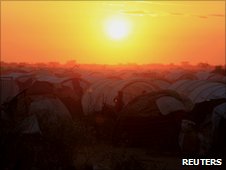
refugee camp
A joint undercover investigation by BBC Newsnight and the Bureau of Investigative Journalism has uncovered evidence that the Ethiopian government is using billions of dollars of development aid as a tool for political oppression.
Posing as tourists the team of journalists travelled to the southern region of Ethiopia.
There they found villages where whole communities are starving, having allegedly been denied basic food, seed and fertiliser for failing to support Prime Minister Meles Zenawi.
The investigation has also gathered evidence of mass detentions, the widespread use of torture and extra-judicial killings by Ethiopian government forces.
Yet Western donors including Britain - which is the third largest donor to Ethiopia - stand accused of turning a blind eye by continuing to provide aid money despite being warned about the abuses. The aid in question is long-term development aid, not the emergency aid provided in response to the current drought in Ethiopia and its neighbours in the Horn of Africa.
Government response
Ambassador Abdirashid Dulane, the Deputy Head of Ethiopia’s UK Mission, has rejected the allegations saying that the Newsnight/Bureau report “lacked objectivity, even-handedness”.
“The sole source of the story was opponents of Ethiopia who have been rejected by the electorate, and time and again it has been shown that their allegations are unfounded”. Our reporters visited one village in southern Ethiopia with a population of about 1,700 adults. Despite being surrounded by other communities which are well fed and prosperous, this village, which cannot be named for fear of reprisals, is starving. We were told that in the two weeks prior to our team’s arrival five adults and 10 children had died.
Lying on the floor, too exhausted to stand, and flanked by her three-year-old son whose stomach is bloated by malnutrition, one woman described how her family had not eaten for four days.
“We are living day to day on the grace of God,” she said.
Another three-year-old boy lay in his grandmother’s lap, listless and barely moving as he stared into space. ”We are just waiting on the crop, if we have one meal a day we will survive until the harvest, beyond that there is no hope for us,” the grandmother said.
‘Abandoned’
In another village 30 km (19 miles) away it was a similar story. There our team met Yenee, a widow who along with her seven children is surviving by begging, eating leaves and scavenging scraps from the bins in the nearest town. ”The situation is desperate,” she said. “We have been abandoned… It is a matter of chance if we live or die.” The two villages sit just 15km (9 miles) either side of a major town, surrounded by other communities where the populations are well fed and healthy. They are in desperate need, but no-one is helping.
According to local opposition members they are being punished for failing to vote for the ruling party, the Ethiopian Peoples’ Revolutionary Democratic Front (EPRDF), which Mr Meles leads. Further north a group of farmers alienated by Mr Meles’ government met the BBC/Bureau team at a secret location on the edge of a remote village. One farmer described how he had been ostracised for failing to support EPRDF: “Because of our political views we face great intimidation. We are denied the right to fertiliser and seeds because of political ideology,” he said.
‘Buying support’
The Ethiopian federal and regional governments control the distribution of aid in Ethiopia. Professor Beyene Petros, the current vice-chairman of the Ethiopian Federal Democratic Forum, an alliance of eight opposition parties known as Medrek, told our reporters that aid is not distributed according to need, but according to support for the EPRDF:
“Almost all of the aid goes through the government channels… in terms of relief food supply and some of the safety net provisions, they simply don’t get to the needy of an equitably basis. ”There is a great deal of political differentiation. People who support the ruling party, the EPRDF, and our members are treated differently. The motivation is buying support, that is how they recruit support, holding the population hostage,” he said.
Mr Beyene said that the international community, including the British government, is well aware of the problem and that he has personally presented them with evidence: ”The position of the donor communities is dismissive… they always want to dismiss it as an isolated incident when we present them with some proof. And we challenge them to go down and check it out for themselves, but they don’t do it.”
Accountability
The UK International Development Minister Stephen O’Brien issued a statement in response to the allegations raised by the investigation, saying: ”We take all allegations of human rights abuses extremely seriously and raise them immediately with the relevant authorities including the Ethiopian Government, with whom we have a candid relationship. Where there is evidence, we take firm and decisive action.
“The British aid programme helps the people of Ethiopia, 30 million of whom live in extreme poverty. We demand full accountability and maximum impact on the ground for support from the British taxpayer.”
The Bureau of Investigative Journalism and Newsnight also gathered evidence of a crackdown and human rights abuses in Ethiopia’s Somali region, the area bordering Somalia and Kenya, also know as the Ogaden region. Ethnic Somali rebels from the outlawed Ogaden National Liberation Front (ONLF) and Ethiopian government forces have been fighting for control of Ogaden since the 1970s. The media and most aid agencies are banned from the region.
Ethiopia, one of the poorest countries of the world, is currently suffering from horrific drought.
Many of those fleeing the ensuing humanitarian crisis have headed to Dadaab refugee camp in northern Kenya. It is the largest refugee camp in the world, and the vast majority of the 400,000 people there are from Somalia, but among them are an increasing number of Ethiopians from the Ogaden.
‘Revenge killings’
Abdifatah Arab Olad, an Ogaden community leader, told our reporters that up to 100 refugees are arriving every month with tales of killings and the burning of villages by government troops. ”Whenever fighting has taken place between the rebels and the army, for each army member that is killed, the military go to the nearest town and they start killing people,” he said. “For each army member killed it equals to 10 civilians losses.”
In the corner of a makeshift shack in the camp, an old woman who had arrived from Ogaden three weeks earlier described being arrested along with 100 others in her village. She said they were taken to a jail where they were locked up in a shipping container, and picked out on a nightly basis to be tortured: ”They beat me then started to rape me; I screamed and fought with them… I tried to bite them… they tied me this way,” she said, gesturing to her legs.
“They raped me in a room, one of them was standing on my mouth, and one tied my hand, they were taking turns, I fainted during this… I can’t say how many, but they were many in the army,” she said.
‘Assaulted when pregnant’
Other women in the camp also said they had been arrested and accused of being members of the OLNF. They included one who said that she was eight months pregnant when she was detained and raped by eight soldiers: ”They were beating me while I was being raped, I was bleeding,” she said, describing how one soldier stamped on her stomach and beat her with the stock of his rifle:
“I fell unconscious when I saw my baby… a man jumping on your stomach, you can imagine what happened to the child, very big kicks blows with the back of a gun. As a consequence of that the child died.” We cannot substantiate these individual allegations. But other credible sources have reported similar stories of the widespread use of rape by Ethiopian security forces against women in the Ogaden.
Speaking on Newsnight, Ethiopia’s Ambassador Abdirashid Dulane said that the claims of rape and torture were a “rehash” of old allegations that the Ethiopian government had answered time and again. ”The Ethiopian government is governed by the rule of law, and human rights and democratic rights are enshrined in the Ethiopian constitution,” he said.
BBC


 +0.00%
 +0.00%
 +0.00%
 -3.80%
 +0.00%
 -2.98%
 +0.00%
 +4.76%
 +0.00%
 +0.00%
 +0.00%
 Asmara
21°
Asmara
21°