


 National emotional baggage has handicapped African carriers, making the continent a lucrative target for foreign attacks. But now Africa’s airlines are ready to fight back, using partnerships to reclaim their territory
African countries are like proud parents towards their airlines. They want them to succeed. They want them to be all they can be. They want to bask in the glory of their offspring. But over-protective parenting can be harmful.
While Africa has focussed on wrapping its airlines in cotton wool, it has taken its eye off the predators lurking nearby. Instead of being protected, Africa’s airlines have been left dangerously exposed. Meanwhile, the wider economy has been neglected. “We have to move past the time when paint on the tail is the heaviest part of an aircraft, even an old aircraft,” says Lance Brogden, IATA regional vice-president for Africa.
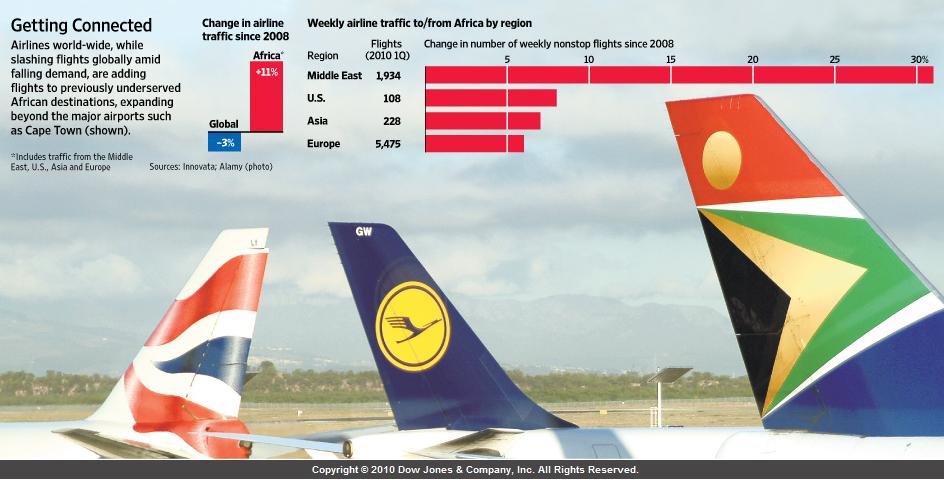
Africa is home to 30% of the world’s land surface and 14.2% of the world population, but accounted for only 3% of world traffic in 2008 despite the lack of alternative transport and harsh terrain. Over the past decade, African air transport has increased by 6.6%, making it the most rapid growth region after the Middle East, albeit from a low base. African GDP is expected to rise by 4.5% in 2011, compared with the world average of 3.7%. The potential is undeniable, but the reality is challenging.
One aviation executive likens travelling across Africa to a game of pool, where you have to rebound off the cushion - in this analogy, Europe or the Middle East - to get to your planned destination. Point-to-point services are limited. Long-haul services are the Holy Grail to aspiring nations, but regional services are what the continent really needs. The rub is that successful long-haul operations need feed, and regional services need liberal markets. Partnerships are also important, but Africa’s carriers have historically been blinkered by their own agenda.
“Instead of building small, regional carriers, everyone has made the same mistake, of wanting long-haul and large widebody aircraft, without developing the vital infrastructure and the hub needed to support it,” says Royal Air Maroc head of industry affairs Souad Meziane. Airlines Association of Southern Africachief executive Chris Zweigenthal agrees: “This is one reason that the grand plans for long haul don’t work: you need a regional base to feed it. The Middle East carriers are using a feed strategy into Africa, and it is working for them.”
Africa’s cash economy has weathered the financial storm better than most, and it remains a premium market, attracting foreign airlines. “Of course Africa is being attacked by international carriers,” says Embraer sales director Patrice Candaten. “Today, Africa is one of the only positive markets. You don’t expect Emirates to attack Europe. They are going to attack you. This is only the beginning.” And it is not just on long-haul. Emirates is involved in the new Senegal Airlines, and Air Arabia has Air Arabia Maroc.
But, as the cake gets divided and eaten, African carriers continue to bicker among themselves. “We have failed as a continent to unite ourselves and exploit our own resources: whose fault is that?” says Air Seychelles chairman David Savy. “The boat has sailed by, and we have missed it.”
The assault continues. Virgin Atlantic has just announced a new service to Ghana from London, and Brussels Airlines will launch four new West African routes in July, swelling its African network to 18 destinations. “Africa is our second home, and this new investment perfectly reflects that,” says Brussels Airlines co-chief executive Bernard Gustin.
Meanwhile, US carriers are returning to Africa, putting huge pressure on local carriers. But sympathy is not on the agenda. IATA’s Brogden delivered a hard-hitting message at the African Airlines Association general assembly, staged in Maputo last November.
“You need to rise to the challenge, otherwise you don’t deserve this continent and you don’t have the right to moan and whine like girls, complaining and crying when someone else takes it away,” says Brogden. “You can’t afford to lose this opportunity. You are already on the back foot. Congratulations to the guys outside this conference [non-African airlines]. They got it right. But it has to stop. Now.”
Nick Fadugba, the new AFRAA secretary general, says 70% of Africa’s long-haul traffic is carried by non-African airlines. “This is damaging to the African airline industry and to the economies of Africa. We welcome non-African airlines in Africa, but we would like to see our member airlines enjoying a greater slice of the pie.”
But in Africa the status quo is plenty of talk and only limited action. And the entry of foreign carriers proves that if you do not seize an opportunity, someone else will. Fadugba is therefore urging African carriers to take concrete action, to communicate with one another and to form true partnerships. “InAfrica we talk a lot about co-operation,” he says. “We talk more than any other country in the world about co-operation, but - in terms of tangible action - we have not got very far.”
PARTNERSHIPS
To help the process along, AFRAA has hinted that it might be looking to set up a partnership scheme, similar to the Arabesk co-operation among Arab airlines. Fadugba says: “Why can’t we have, in Africa, an African airline alliance with an à la carte menu? I’m not talking about equity. I’m talking about a concrete, tangible strategy to move airlines forward, with co-operation in areas such as simulator training, maintenance and spares pooling. You can compete for traffic on one hand but also co-operate to gain benefits.”
Dapo Olumide is chief executive at newly renamed Nigerian Eagle, which was formerly known as Virgin Nigeria. Olumide agrees with Fadugba, but he is quick to note: “We don’t want to create Air Afrique, some monster which is not going to survive. The world is changing and we don’t have the resources to do it on our own. Even British Airways is not capable of creating the network it would like, so it has to go to partners.”
AFRAA is also urging the continent’s largest players to work with smaller carriers to create codeshares, joint ventures, cross-border and equity partnerships. Ethiopian Airlines is already fulfilling this mission, as a part-owner of Togolese start-up ASKY. But chief executive Girma Wake is keen to see more action. “Have we done enough as airlines? I don’t think our governments would tell us to only maintain aircraft from airline X, Y or Z. If we train staff at one another’s facilities, I don’t think the governments would interfere. But we feel more honoured to work with a big European carrier than to form partnerships among ourselves. This has to be washed out of our systems. Let’s knock on one another’s doors and work together, rather than just working with somebody, somewhere.”
Another example of a big carrier teaming up with a smaller sibling is Tanzania’s Precision Air, which is 49%-owned by Kenya Airways. “I think the message of co-operation is not a fancy, trendy word, but an absolute necessity for Africa,” says Kenya Airways chief operating officer Bram Steller.
And others are looking to join the throng. Gidon Novick, joint chief executive of South Africa’s Comair, says: “We are certainly looking to see how we can help other African carriers, in terms of partnering with them and helping them to become sustainable, reliable airlines.” Comair is looking at several partnership opportunities across southern Africa.
SURVIVAL INSTINCT
But while African airlines recognise the need to consolidate their resources and work together, there is a huge amount of fear and mistrust that larger players will take advantage of their smaller brothers. Zweigenthal says: “Many carriers think that, if they co-operate, they will get dominated and blown out of market, but the sooner we co-operate together, the better.”
“It is a question of building up the confidence of both partners,” says LAM Mozambique commercial director Aderito Macaba. “When the sun rises, both lions and gazelles run: one to eat, the other not to be eaten. We would like to be a small lion and not a gazelle. If we want to succeed we must work hand-in-hand. It is time to wake up and run, for all of us.” Acting as one pride, he believes, is the key for survival.
Mind-set and a lack of communication are still huge obstacles for African aviation. “Sometimes the big players think they are big and that the others are nothing,” says LAM chief executive Jose Viegas. “All they seem to do is complain about their bigger brothers. How are we supposed to ask for their support if they would like to kill us?”
On the flip side, the bigger players are keen to shed their bully-boy image. “The problem is, we are small on the world stage and too big on the African market,” says Kenya Airways’ Steller. “We don’t want to be seen to overwhelm smaller players: co-operation is our goal, not ownership. Our philosophy is to develop a joint market, not to rob someone else.” Wake from Ethiopian is also keen to put things in context. “There is no big carrier in Africa. The largest big carrier in Africa is the same size as the smallest European carrier.”
Wake accepts that, at least in the short term, partnerships can involve sacrifice, but he believes co-operation and idea sharing will lay “proper foundations” for the difficult times. “If all want to win, it just doesn’t work. We have to start to change our mentality,” he says. “I believe, without co-operation, African carriers will find it very, very difficult in the short-term, let alone the next five years.”
POLITICAL BICKERING
Fadugba is also calling for co-operation at national level and he has struck out at a lack of progress towards liberalisation, saying: “The African economy will only start to thrive once political bickering is eliminated.”
Based on the 1988 Yamoussoukro Declaration, the legally-binding 1999 Yamoussoukro Decision set the scene for gradual African air transport liberalisation, through bilateral and multilateral agreements.
“For many people, Yamoussoukro has been on paper gathering dust for 20 years,” says Fadugba. “This is no credit to Africa. We must realise that the real competition is not between ourselves, but betweenAfrica and the rest of the world. Ghana must not look at Equatorial Guinea as a competitor. We have to work together to move forward.”
Some African carriers are still denied market access within their own continent, and Fadugba describes this situation as extraordinary and unacceptable. “Some African states, which have ratified these legally binding documents, have done nothing. This means many airlines are hamstrung when it comes to developing their networks within Africa.” But he also criticises markets that have liberalised their international markets too rapidly, creating an influx of foreign competition, undermining Africa’s airlines and economies.
The African Civil Aviation Commission has been tasked with overseeing progress towards Yamoussoukro and Fadugba intends to work closely with the commission to move things forward. But while progress towards Yamoussoukro’s heady ambitions is widely criticised, very little research has been done, prompting World Bank principal air transport specialist Charles Schlumberger’s doctoral thesis.
Implementation of the Yamoussoukro Decision is being handled by regional organisations, and Schlumberger’s research shows that these bodies are making headway. Several African carriers are already benefiting from Yamoussoukro Decision-conforming bilaterals. He also found that the number of seats offered typically fell in Africa’s liberalised markets. Schlumberger proposes that this is caused by the right-sizing of capacity and the system being cleansed of non-viable airlines.
Looking forward, Schlumberger’s report observes that a “clear majority” of African countries favour full application and countries which have dominating state-owned carriers, such as Egypt, Ethiopia, Kenya, Morocco and South Africa, are pressing ahead. But 20 countries with weak or small state-owned carriers are still dragging their heels. “Where there is very little air transport, there is not a problem. Where airlines are privately owned, there’s not a problem,” says Schlumberger. “The issue lies with ailing flag carriers.”
Although some policy work still needs to be processed by the regional bodies,Schlumberger believes that states forming bilateral deals “may set the motivating example to set up these missing elements”. Royal Air Maroc’s Meziane agrees with the professor: “If things progress, it will only be thanks to the carriers themselves.”
Her views are seconded by Nigerian Eagle’s Olumide: “Governments talk the talk, but they don’t walk the walk. But huge steps have been taken. We’ve now recognised that we shouldn’t leave it to the government. Airlines have to do it themselves.” The liberalisation research supports this. “Royal Air Maroc and Ethiopian have developed strongly, based on bilateral relationships and that is the way forward,” says Schlumberger. “This is how we move forward, not through another two-week conference. Yamoussoukro is alive. People like [Ethiopian's] Girma Wake and Royal Air Maroc are going out to other countries and asking them if they want to come. This is how you implement Yamoussoukro.”
A further issue looming on the horizon is Africa’s inability to negotiate as a block when faced with the might of Europe. Tunisair manager for international affairs and alliances Koussai Mrabet says: “This is difficult, but it is important. The impact of not doing this will be that a lot of African carriers will disappear. The will of the group is better than the will of an individual: 20 are obviously stronger than one. EU carriers can gain the right to fly every route in Europe to Tunis. This is a big danger, especially with low-cost carriers.”
LOW-COST CHALLENGE
Morocco has actively liberalised its market, attracting a deluge of low-cost operators. Since signing key deals with Europe and the USA, tourism figures have leap from 2.2 million to 8.5 million, creating 200,000 new jobs. New private operators such as Jet4you have sprung up and Royal Air Maroc doubled its fleet to 52 aircraft. “Liberalisation has clearly been a success in Morocco,” says Royal Air Maroc chief executive Driss Benhima. “In the first phase Royal Air Maroc did very well, expanding its passengers and doubling its fleet. Now I think the rules are changing.”
Benhima, who is a former transport minister, insists that “development of the national carrier should take second place to liberalisation”, even if this means “losing some ground”. Indeed, Royal Air Maroc has had to refocus on its home market since liberalisation, abandoning its other African airline ventures - many of which were separately hampered by political pressures.
“Transport ministers are not here to protect the national flag carrier; they are here to increase air transport. If it gives tourists increased frequencies and cheaper fares, liberalisation can address national interests. You don’t have to have a national carrier and I don’t think national policy should be to protect the flag carrier at any cost.”
Benhima says states fear losing their national carrier because international routes subsidise vital domestic and regional operations. But Morocco is addressing this issue by using taxes from its newly expanded traffic base to support its fully liberalised domestic market, where operators do not have to pay taxes.
Regional routes are fundamental to Africa’s economic growth. Embraer’s Candaten says Africa’s 70% load factor sits at the bottom of the world league table, while 600 routes lack a daily frequency, showing overcapacity. Only 16% of Africa’s routes are daily. “If you want to go from A to B you have to go via E, F and G,” says Candaten. “Consumers want to fly the shortest way, the fastest way.”
Bombardier statistics show that 75% of Africa’s scheduled operations are domestic, whereas in a mature market the majority are regional. Bombardier Commercial Aircraft marketing and airline analysis manager Frederic Morais says today there are 751 non-stop markets served in Africa, but there is potential to add a further 386 regional routes, including 70 from the continent’s major hubs.
“On domestic and regional services, there are no excuses. We have nobody to blame apart from ourselves,” argues Fadugba. “There are too many excuses for not developing domestic air transport and nobody takes the blame. In reality, there are no excuses for not developing regional air transport.”
But the challenges are clear. Benhima states that he has 4,500 staff and neatly sums up the problem. “This means I have 4,500 chief executives and, in the country as a whole, I have about 30,000 consultants. The relationship between the public and their national carrier is same as the relationship between the public and their national soccer team.”
Brogden from IATA concludes: “We have made a lot of progress. My commitment is ‘no more meetings, only action’. The foundations have been laid. Returns will come from liberalisation, but we must be careful not to blame the governments for being slow. We are accountable. We are the ones to make the changes. It’s far too easy to say, ‘Let’s just look after our own airline.’ There’s no way we can do this unless we throw away our arrogance and work together.” Source: (ATI)

 +0.00%
 +1.94%
 -2.25%
 +0.00%
 -2.77%
 +5.02%
 +0.00%
 +0.00%
 +1.36%
 +2.55%
 +0.58%