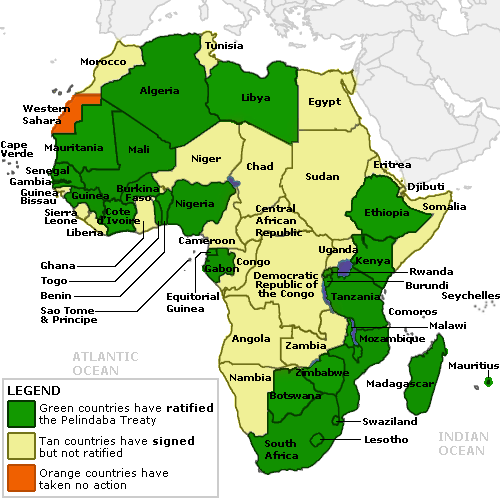
Treaty of Pelindaba
The Third Conference of member states of the African Nuclear-Weapon-Free Zone treaty, known as Treaty of Pelindaba, opened at the AU Headquarters on Thursday.
The Conference is being attended by member states, as well as by relevant regional and international organizations, including the International Atomic Energy Agency (IAEA), the Preparatory Commission of the Comprehensive Nuclear-Test-Ban Treaty Organization (CTBTO) and the Forum for Nuclear Regulatory Bodies in Africa (FNRBA).
The Treaty of Pelindaba (The African Nuclear-Weapon-Free Zone Treaty) was adopted by the Ordinary Session of the Organization of African Unity (OAU) in June 1995 and was later signed in Cairo in April 1996.
The Treaty of Pelindaba requires States Parties to renounce nuclear explosive devices, particularly to refrain from conducting research, developing, manufacturing, stockpiling or otherwise acquiring, possessing or having control over any nuclear explosive device, as well as from encouraging, receiving, providing or seeking any assistance to these ends. It also prohibits stationing and testing of nuclear explosive devices on the Zone, as well as dumping of radioactive wastes.
The Treaty further requires States Parties to declare, dismantle, destroy or convert nuclear explosive devices and facilities for their manufacture; and to use nuclear science and technology for exclusively verifiable peaceful purposes, while maintaining physical protection of nuclear materials and facilities. It also prohibits armed attacks on nuclear installations.
There are currently 38 States Parties to the Treaty of Pelindaba. These are: Algeria, Benin, Botswana, Burkina Faso, Burundi, Cameroon, Chad, Côte d’Ivoire, Comoros, Congo, Equatorial Guinea, Ethiopia, Gabon, Gambia, Ghana, Guinea-Bissau, Guinea, Kenya, Libya, Lesotho, Madagascar, Mali, Malawi, Mozambique, Mauritania, Mauritius, Namibia, Nigeria, Rwanda, the Sahrawi Arab Democratic Republic, Senegal, South Africa, Swaziland, Tanzania, Togo, Tunisia, Zambia and Zimbabwe.
Eritrea has signed but has yet to ratify the treaty like Angola, Central African Republic, Cape Verde, Djibouti, Democratic Republic of Congo, Egypt, Liberia, Morocco, Niger, Seychelles, Sierra Leone, Somalia, Sao Tome & Principe, Sudan and Uganda.
The Conference will review the activities of the African Commission on Nuclear Energy (AFCONE), including the implementation of its programme of work and budget. The Conference will also discuss the status of the operationalization of the AFCONE Secretariat and other related issues. The Conference will finish on Friday the 30 May 2014.