
African Chinese Entrepreneurs
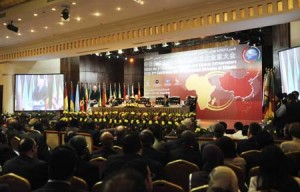
The Common Market for Eastern and Southern Africa (COMESA) reports that it participated at the third Conference of African and Chinese Entrepreneurs in Sharm el Sheikh, Egypt from 7th to 8th November 2009.
The organization was represented by Assistant Secretary General (Programmes), Mr. Stephen Karangizi, who pointed out that there is increasing evidence that Regional Economic Communities on the continent are working more closely together to realize the dream of Africa which is to integrate Africa.
A good example of this was the launch of the COMESA-EAC-SADC Tripartite arrangement in October 2008, at which the 26 Heads of State of the three regional economic communities agreed to establish a Grand FTA stretching from Egypt and Libya to South Africa. In addition, the Heads of State also agreed on the eventual merger of the three institutions.
This augurs well for regional integration in Africa and for all potential investors as the removal of trade barriers of such a large region offers huge economies of scale. “We also believe that this new impetus opens the best way in which the building blocs recognized by the African Union, can rapidly contribute to the establishment of a larger African Economic Community”.
Mr. Karangizi added that through regional integration, Africa intends to create one large continental market of approximately one billion people that is competitive and offers all the productive and service sector economies of scale. Indeed the China example, which is the single largest integrated market in the world, offers the best lessons. The rapid growth of the economy of China over the past 20 years owes much to the large market of over 1.3 billion people.
In order to create a large continental market, the RECs have been concentrating on: removal of tariff barriers which has already been done by COMESA with the establishment of Free Trade Area stretching from Egypt and Libya in the north, to Swaziland and Mauritius in the south, reducing the range of non-tariff barriers, improving customs procedures and charges; and improving access to market information.
Mr. Karangizi said it is easier to invest in infrastructure projects on a regional basis in order to enhance intra-regional trade and address the uneven historical focus of having infrastructure designed to serve only the metropolis and export of raw materials.
However, RECs do recognize that there are several challenges to increase investment in infrastructure. One of the challenges is that most countries do not have the financial resources for investment in infrastructure projects, which require large capital outlays and are characterized by long gestation periods.
The traditional approach has been to obtain funding from multilateral development banks and development partners. This type of funding increases the debt stock and burden of countries. Hence, the need for public/private sector partnerships. It is gratifying to note that this is happening with respect to power and telecommunications projects.
Mr. Karangizi revealed that emphasis by Heads of State on regional integration is intentional so as to focus on five important factors, namely: Establishment of a large regional market to enhance competitiveness, Investment in infrastructure (energy, transport network, water and ICT), Investment in Productive and Services Sectors, Policy Harmonization and Regulation and Addressing Peace and Security Issues.
On expanding private/public partnerships, creative and innovative approaches are required for infrastructure financing such as the regional funds like the COMESA Infrastructure Fund, which has been established for pooling together resources to be leveraged for private sector investment in selected priority projects. In the near future, Member States of the Infrastructure Fund will be approaching selected private sector institutions that can participate in infrastructure investment in the region in partnership with the public sector.

 +0.00%
 +6.01%
 +10.84%
 +0.00%
 -2.59%
 +5.76%
 +0.00%
 +0.00%
 +2.56%
 +4.09%
 +2.36%